
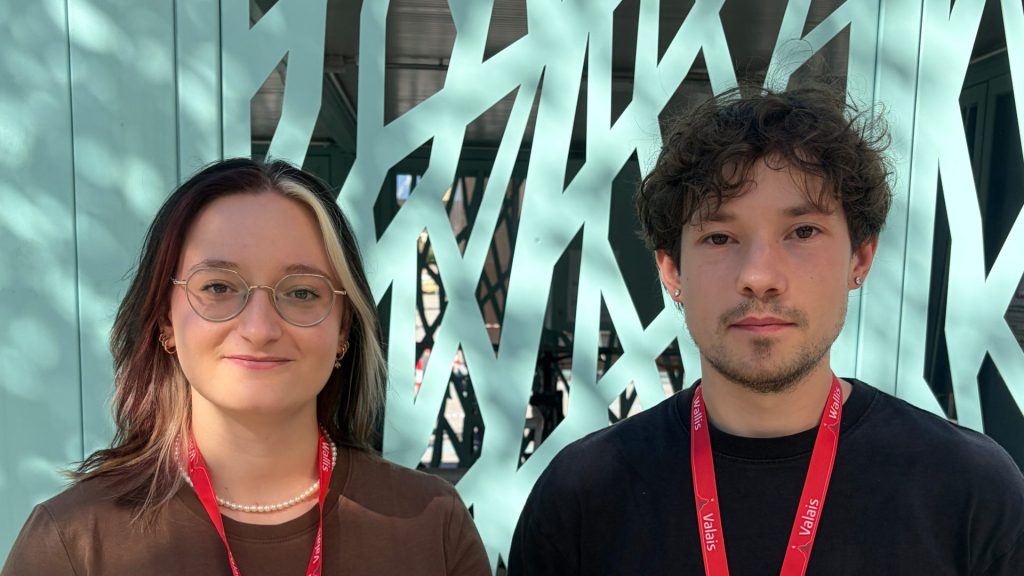
Portraits of the 2026 Summer School in Sion: Justin Michod and Maé Clet
 Verified listing
- More information on website
- prev
- next
News article
Justin Michod and Maé Clet
BSc Biotechnology, entering 3rd year, HES-SO Institute of Life Sciences
Tell me about the Bachelor programs at your school.
At HES-SO Life Sciences there are four orientations for the bachelor’s degree: biotech, analytical chemistry, digital life sciences, and food biotech. The digital life sciences orientation is new. Both of us are in the biotech orientation.
What are your study and research interests?
Justin: Definitely pharma, for example antibodies and vaccines. I want to focus on developing medicines.
Maé: One area that interests me is tissue engineering. Process development could also be something, for example what Julia Müller presented this morning in continuous chromatography. Then I recently saw a documentary about people making a database of plants that are threatened by extinction, and that also piqued my curiosity. What I’m not interested in is process analytics or quality control, which has too much standardisation for me.
Why did you decide to attend the summer school?
Maé: For me it’s a start in building a network and meeting new people.
Justin: I’m surprised how much content spanning a big range of topics is packed into these few days. I’m trying to wrap my head around everything I’ve heard and stay alert!
Do you have a favourite talk or session so far?
Maé: Aside from Julia’s talk, I also found the one on Zebrafish interesting, due to their ‘similarity’ to humans, although they’re such simple organisms. The potential to reduce the use of mice in drug development is very positive.
Justin: The Zebrafish talk was also a favourite of mine. I had no idea that the number of vertebrae has an impact on the classification of this organism and what kinds of studies can be done with it. The talk about microscopy inside a working bioreactor, where you can see photos of cells growing, was also pretty cool.
What are your plans after you complete your bachelor’s degree?
Justin: I’d like to do a master’s on developing medicines, and I’m considering two programs. One is more academic, focusing on basic research at the University of Basel, while the other is applied, with a stronger connection to industry at the ZHAW in Wädenswil.
Maé: I haven’t looked into all the details of a master degree yet, but staying closer to home is a priority for me. HES-SO could be an option, or somewhere where I can come back on the weekends. Or, on the other end of the spectrum, going abroad!
What kind of company would you like to work at later, or do you think you’ll end up with a career in university?
Justin: I’m not in a hurry to go work in industry, and doing a PhD is something I could envision. It really helps to have the support of my family so that I can develop as a person and student over time, and find the right path.
Maé: I also plan to take my time in choosing my path, but I don’t think I’ll end up doing a PhD.
Published
- 17 September 2026